

 GO TO BOTTOM
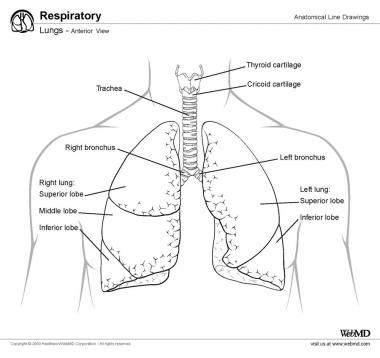
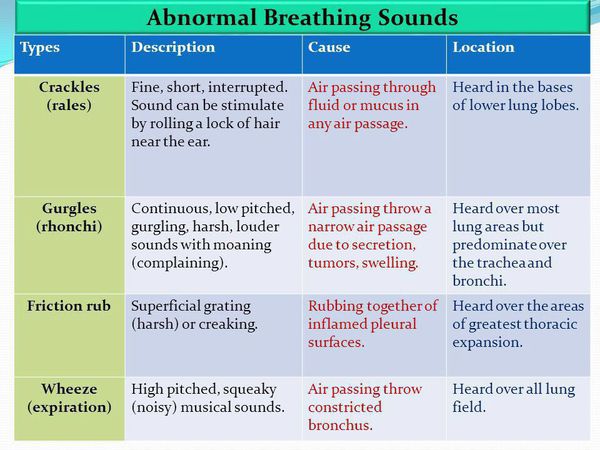
 Crackles: Also called rales, crackles tend to sound like discontinuous clicking, rattling, or bubbling when the person inhales. Crackling breath sounds may sound wet or dry, and doctors might describe them as either fine or coarse. Wheezing: Wheezing noises are high-pitched and continuous and may sound like a breathy whistle. Sometimes, wheezing can be loud enough to hear without a stethoscope. A squawk is a short version of a wheeze that occurs during inhalation. Rhonchi: Rhonchi are continuous, lower-pitched, rough sounds that many people compare to snoring. Stridor: Stridor is a harsh, high-pitched, wheeze-like sound. It occurs in people who have a blocked upper airway, usually when they are breathing in.
 asthma acute bronchitis bronchiectasis, an abnormal widening of the airways in the lungs chronic obstructive pulmonary disease (COPD), including emphysema and chronic bronchitis
an object stuck in the lungs or other airways pneumonia interstitial lung disease pulmonary edema, which may relate to congestive heart failure or end-stage renal disease
asthma acute bronchitis bronchiectasis, an abnormal widening of the airways in the lungs chronic obstructive pulmonary disease (COPD), including emphysema and chronic bronchitis
an object stuck in the lungs or other airways pneumonia interstitial lung disease pulmonary edema, which may relate to congestive heart failure or end-stage renal disease Crackles: Crackles commonly happen as a result of fluid accumulation in the lungs. Conditions such as pneumonia or left-sided heart failure may cause this buildup. Wheezing: Wheezing is a common symptom of conditions that narrow the small airways in the lungs, such as asthma and COPD. Rhonchi: Rhonchi occur due to conditions that block airflow through the large airways, including the bronchi. There may also be inflammation and fluid in these airways. Conditions such as acute bronchitis and COPD may cause rhonchi. Stridor: Stridor occurs in people with an upper airway blockage. A blockage may occur if a person breathes in a foreign object, chemical, or other harmful substance. A traumatic neck or chest injury involving the upper airway could result in a blockage too. Stridor can also be a symptom of inflammatory conditions, such as tonsillitis, epiglottitis, or croup (laryngotracheitis). bending forward and using the abdominal muscles or neck muscles to assist or force breathing nasal flaring when breathing the skin turning blue, especially in the lips or face stridor, which means that the person has an upper airway blockage and may be choking or having an acute allergic reaction.
 FACEBOOK PAGE
  Time and Date: 09/20/26

 Now Online: 1
 Your IP: 216.73.217.70
 Daily Visit: 1
Monthly Monitoring: 2
Daily Visit: 1
Monthly Monitoring: 2
 Total Visitor: 53
 Subscribers: 2
 Members: 0
 Guestbook: 1
 GO TO TOP
 Admin Only

